Riddles Test - 500 Brain Games
- 4.3
- Rating
- 1.00M
- Installs
- Free
- Price
 Analysis by App-foxy
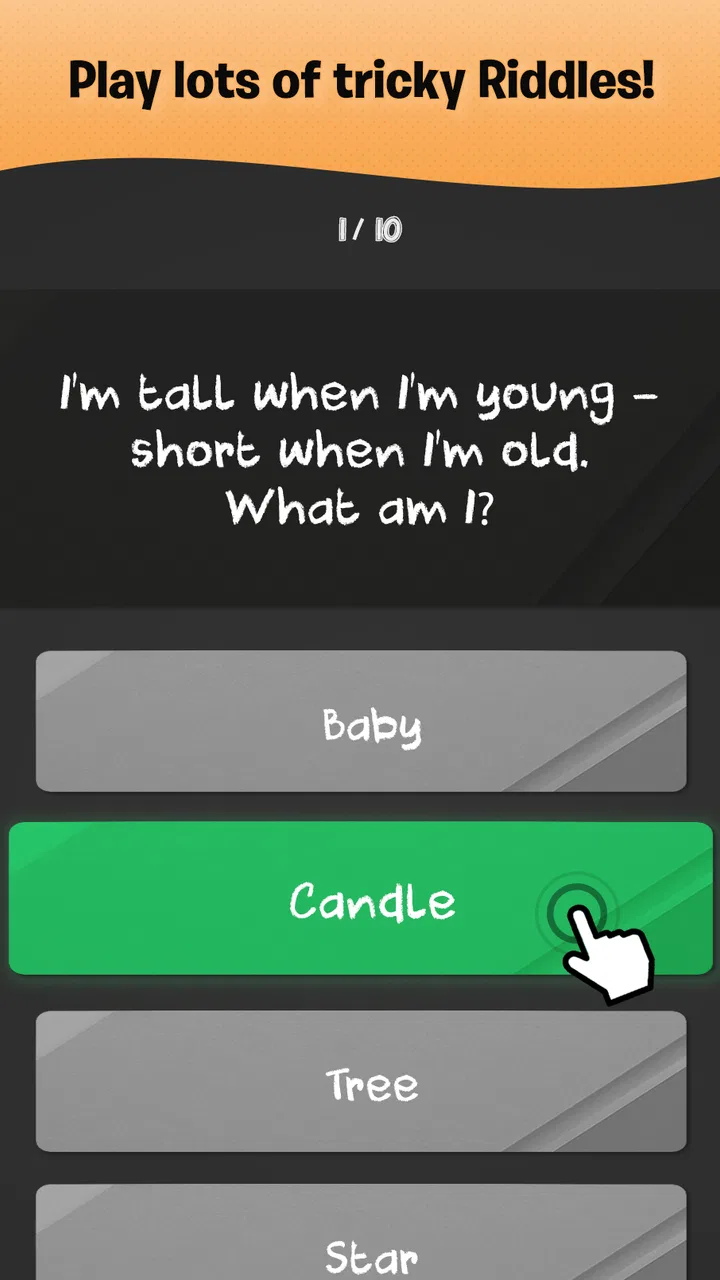
I approached Riddles Test - 500 Brain Games as a quick-thinking trivia game rather than a formal learning tool. It is built around riddles, tricky questions, and IQ-style challenges, so the appeal is simple: open it when you have a few spare minutes, read a puzzle, and try to find the answer before a misleading detail sends you in the wrong direction. I found that straightforward format easy to understand, but the experience depends heavily on how patiently you read each question.
Idle Boots developed the game, which is available for free and carries an Everyone age rating. It has been around since September 20, 2017, and its current version is 27, with Android support starting at 5.1. Its average score sits at 4.3 from around 40 thousand ratings, while its reach has passed one million installs. Those figures suggest that the basic riddle format has found a substantial audience, although popularity alone does not make every puzzle a good fit for every player.
Where the experience usually gets difficult
The first obstacle is not installation; it is adjusting to the wording. A normal trivia question often rewards remembered knowledge, while a riddle may reward noticing one unusual word or refusing to make an obvious assumption. I regularly found myself solving the general idea too quickly and missing the small twist that the question was actually testing. That can feel satisfying when the answer clicks, but irritating when the wording seems more important than the subject.
You May Also Like

 Blood Strike: 2.5 Anniversary
Blood Strike’s Loadouts Turn Every Drop Into a Tactical Gamble
A close look at Blood Strike’s custom loadouts: how fast access to signature weapons reshapes its battle royale rhythm, rewards preparation, and narrows the gap between fights.

 Pandora - Music & Podcasts
Pandora’s Music Is Easy to Start, but Harder to Recover
Pandora’s strength is its low-effort path from a seed to a station. Its weak spot is how much confidence it asks you to place in connection, setup, and quiet recovery.

 8 Ball Pool
 Is Built on Rivalries, Rematches, and Routine
A close look at the rivalries, rematches, shared routines, and unanswered safety questions that turn a quick pool match into a persistent mobile community.

 Samsung Music
’s Quiet Strength Is Playing What You Already Own
Its reach comes less from spectacle than from dependable access to a personal library. That simplicity is both the app’s strongest retention engine and its ceiling.

 AccuWeather: Weather Radar
AccuWeather Review: A Quick, Clear Forecast for Everyday Decisions
For everyday plans, the best forecast is the one you can understand quickly. AccuWeather makes rain timing, radar, and local conditions easy to act on, with a few trade-offs.

 Hill Climb Racing
Why Hill Climb Racing Still Turns Crashes Into One More Run
A tiny car, a bumpy hill and one more upgrade: Hill Climb Racing keeps resurfacing because its simple chaos makes every near-miss feel personal.
More From Our News Desk



This is especially noticeable if you expect a conventional IQ test. The game presents brain teasers and tricky puzzles, but I would not treat every challenge as a scientific measure of intelligence. Some questions test lateral thinking, some test familiarity with common riddle patterns, and others mainly test whether you read the sentence literally. That variety keeps the session from feeling like a school worksheet, yet it also means a wrong answer is not always evidence that you lack the required ability.
The most useful habit is to pause before tapping an answer. I read the question once for its apparent meaning and a second time looking for restrictions, odd phrasing, or an assumption I have made automatically. This small change makes the game feel less like guessing and more like a conversation with a mischievous question writer. It also reduces the frustration of choosing the answer that sounds sensible in everyday life but does not match the puzzle’s intended logic.
Another point of friction is the compact nature of the format. A short riddle has little room to explain its reasoning, so the satisfaction often comes from the answer itself rather than from a detailed lesson afterward. If you enjoy discussing why a solution works, you may want to keep a note of the puzzles that surprise you and revisit them later. If you prefer every answer to include a careful explanation, this game may feel lighter than a dedicated educational brain-training product.
What to expect from a short session
I think the game works best in small bursts. A few puzzles during a commute, a break, or while waiting for an appointment give each question enough attention. Longer sessions can become repetitive if you are looking for increasingly sophisticated problems, because the core activity remains reading, interpreting, and answering riddles. The free entry point makes experimentation easy, but it does not change the fact that this is a focused puzzle collection rather than a broad trivia encyclopedia.
A realistic everyday use is a family waiting for food at a restaurant. One person can read a riddle aloud, everyone can offer an answer, and the discussion becomes part of the entertainment. The Everyone rating makes that kind of shared use approachable, though I would still read each question myself before handing a device to a younger child. Age labels describe general suitability, not whether every individual puzzle will match a child’s reading level or interests.
It can also work as a personal reset between demanding tasks. I like the way a single riddle gives my attention a narrow target without requiring a long commitment. However, I would not use it as a replacement for structured study, memory practice, or a serious reasoning assessment. The game is at its best when the goal is playful mental stimulation, not measurable progress in a particular academic skill.
Setup checks before blaming the game
Because the game supports Android 5.1 and later, the first practical check is the device itself. If the installation option is unavailable, the operating system may be below that requirement or the device may not have enough working storage for the installation process. I would check the Android version and free space before repeatedly trying the same download. This is a more useful first step than assuming the game is broken.
The next check is whether the installation actually finished. A partially completed download can leave an icon that behaves strangely or an app that opens and closes immediately. I would restart the device, confirm that the game appears normally in the installed-app list, and open it again before changing anything more complicated. A simple restart often separates a temporary setup problem from a repeatable app problem.
If the game starts but the text is difficult to read, I would first inspect the phone’s display settings rather than assuming the puzzle content is missing. Screen magnification, unusual font settings, or display scaling can affect how comfortably a short riddle fits on screen. Since the game depends on precise wording, readability matters more here than it would in a game with mostly visual controls.
For a child or shared family device, I would also test the game in the same profile that will actually use it. A title that opens correctly for the owner may behave differently under another device profile or after parental restrictions are applied. I would keep the check general: install it from the normal store, open it once, and make sure the intended player can reach the puzzle screen without needing the owner’s account.
It is worth remembering that the game is free, but free does not mean every technical issue is automatically solved by reinstalling. Before removing it, I would note whether the problem happens during installation, at launch, while moving between puzzles, or only when the device is under heavy load. That detail helps identify the next sensible step and prevents losing time on unrelated fixes.
A calm recovery routine
When a session stops responding, I would use a simple sequence: close the game, wait briefly, reopen it, and then restart the phone if the same behavior returns. I would avoid tapping repeatedly, because rapid inputs can make it harder to tell whether the screen is frozen or simply taking a moment to react. If other apps are also sluggish, the phone’s available memory or general system condition is a more likely starting point than one riddle game.
If the issue appears only after an update or only on one device, I would compare those circumstances carefully. The current version is 27, but a version number by itself does not explain a failure. What matters is the pattern: does the game fail every time, or only after the phone has been running for a long period? Does it fail on launch, or only after several puzzles? Recording those observations gives a clearer basis for deciding whether to wait, restart, or reinstall.
Reinstallation should be a later step, not the first reflex. Removing an app can clear local state, and I would only do it after considering whether any session progress might be stored locally. I would also make sure I can install it again through the normal store before deleting it. This is particularly sensible for a puzzle collection, where the cost of losing a current position may be more annoying than the original technical problem.
When a puzzle seems to accept an unexpected answer, I would first reread the wording and try the intended interpretation rather than treating the input as a software error. Riddles are deliberately indirect, and a correct response may depend on a literal detail that is easy to skip. The practical test is consistency: if many unrelated questions behave strangely, investigate the app; if one question is confusing, investigate the wording first.
When the app is not the cause
Some apparent failures come from the surrounding device. A nearly full phone can make installations and launches unreliable. Aggressive battery-saving settings can interfere with apps that have been left idle. A damaged screen protector or an unresponsive area of the touchscreen can look like a missed answer. I would test the same part of the screen in another app before concluding that the game ignored a tap.
Reading conditions matter too. Glare, a dim display, or a noisy room can make a short riddle seem badly written because the player misses a crucial word. I found that many puzzles reward close attention, so even a small distraction changes the result. In a group setting, I would have one person read the question aloud exactly as written instead of paraphrasing it; changing one phrase can remove the trick the puzzle depends on.
Connectivity expectations can also create confusion. I would not assume that every part of the experience must behave like a connected online service simply because the game was installed from an app store. If a screen does not load, I would check the connection once, then retry after reopening the game. If the rest of the phone has normal access and only one screen remains stuck, that points more toward a temporary app state than a general network failure.
Likewise, a low score after a few attempts does not necessarily indicate poor quality. Riddle games are subjective: one player enjoys wordplay, another prefers factual questions, and a third dislikes answers that rely on a familiar joke or convention. I would judge the game over a reasonable sample of puzzles and ask whether the challenge feels fair enough to be enjoyable, not whether every answer matches my preferred style of reasoning.
How it compares with other ways to play trivia
Compared with a standard quiz app, this game places less emphasis on broad factual recall. You are not mainly competing against a timer or building a knowledge profile; you are trying to detect the hidden angle in a question. That makes it a better choice for people who enjoy wordplay and lateral thinking than for someone who wants geography, history, science, or current-events practice.
Compared with a formal brain-training app, it is more casual and less structured. I would choose this game when I want a quick puzzle without committing to a daily program. I would choose a more structured alternative when I want progress tracking, a defined skill focus, or exercises that can be compared over time. The distinction matters because the phrase “IQ test” can create expectations that a collection of riddles is not designed to meet.
Compared with paper puzzle books, the app is more convenient for carrying a selection of challenges in a phone. A book can be better for people who dislike screen time, want to write notes beside a puzzle, or prefer a slower shared activity. The app wins when I have only a short wait and no physical material with me. Neither format automatically provides better reasoning; the difference is mainly convenience, presentation, and how you like to interact with the questions.
Against multiplayer trivia, the game feels more relaxed. There is no need to coordinate with opponents or wait for a match, which is useful when I am offline or only have a moment. The trade-off is reduced social energy. If your main motivation is rivalry, live scores, or discovering how your answer compares with a group, a multiplayer quiz will probably hold your attention better.
Small techniques that improve the experience
My first technique is to separate the surface question from the constraint. I ask myself what the sentence explicitly says, then what it merely suggests. This is particularly helpful when an everyday assumption is doing most of the work. I also avoid searching for an answer immediately; giving myself a short, honest attempt makes the eventual solution more memorable.
My second technique is to use the game as a conversation starter rather than treating every puzzle as a private test. Reading a riddle to another person exposes hidden assumptions quickly, and different interpretations can be more entertaining than the official answer. This works well with family members, but it is also useful when you want to check whether a question is genuinely clear or only seems clear after you already know the solution.
My third technique is to keep a simple “trick types” note outside the game. I might record that a puzzle depended on literal wording, a double meaning, a visual assumption, or an everyday convention. After several sessions, this helps me recognize the kind of thinking being invited without memorizing individual answers. It turns a casual collection into a more deliberate exercise in reading and reasoning, while still keeping the experience light.
I would also stop a session when frustration starts replacing curiosity. Continuing to tap through puzzles while annoyed makes every ambiguous question feel unfair. A short break usually works better than forcing a perfect run. Since the game is free, there is little pressure to extract a fixed amount of value from one sitting; its strongest use is as an optional mental diversion that you can return to when the mood suits you.
My practical verdict
I recommend this trivia game to people who enjoy riddles, wordplay, and questions that punish quick assumptions. Its free format, Everyone rating, and modest Android requirement make it easy to try on a wide range of devices. I especially like it for short breaks, family discussions, and anyone who wants a puzzle collection without the competitive pressure of live quiz games.
I would skip it if you want a rigorous intelligence assessment, a detailed educational explanation after every answer, or a deep progression system built around measurable skills. I would also look elsewhere if your ideal trivia experience is based on factual categories and current knowledge rather than lateral thinking. Those are not small differences; they determine whether the game feels pleasantly surprising or simply vague.
The main lesson from using it is to treat the wording as the real control system. Careful reading improves the experience more than fast tapping, and most confusing moments are worth examining before they are labeled technical faults. Its best value is as a compact, low-pressure way to make ordinary spare minutes more mentally active. With realistic expectations and a patient approach to tricky phrasing, Riddles Test - 500 Brain Games is an enjoyable recommendation for casual puzzle fans, even if it is not a substitute for a structured quiz or brain-training app.
FAQs for Riddles Test - 500 Brain Games
01What is Riddles Test - 500 Brain Games?
Riddles Test - 500 Brain Games is a puzzle and trivia-style app built around a large collection of riddles. It challenges you to read each question carefully, identify hidden clues, and choose or enter the most logical answer. The difficulty varies from simple wordplay to more deceptive brain teasers, making it suitable for short sessions or longer attempts when you want to exercise your reasoning skills.
02Is Riddles Test - 500 Brain Games suitable for children?
The app can be enjoyable for older children, teenagers, and adults, especially those who like word puzzles and lateral-thinking challenges. However, some riddles may be difficult for younger users or depend on language, cultural references, and vocabulary. Parents should check the app’s age rating and review its content before allowing children to play independently, particularly if advertising or optional purchases are available.
03Does the game require an internet connection?
Many riddle apps allow at least part of their content to be played offline after installation, but the exact behavior can depend on the version and device. An internet connection may still be required for advertisements, updates, analytics, or restoring purchases. If offline access matters to you, test a few levels after switching off mobile data and Wi-Fi rather than assuming every feature will work without connectivity.
04Are there hints, solutions, or ways to skip difficult riddles?
Riddles are designed to make you think, so some questions can feel surprisingly challenging even when the answer appears obvious afterward. Depending on the current version, the app may provide hints, reveal solutions, or let you move past a puzzle after watching an advertisement or using an in-game resource. These options are helpful, but they can reduce the satisfaction of solving each riddle unaided.
05Is Riddles Test - 500 Brain Games free to download and play?
The application may be available to download without an upfront charge, but free access does not always mean that every feature is completely unrestricted. You may encounter advertising, optional in-app purchases, or limits connected to hints and progression. Before downloading, check the Google Play or App Store listing for the latest pricing, subscription details, permissions, and any information about removing advertisements.
Pros
- 500 puzzles provide plenty of content for repeated play.
- Difficulty variety suits both casual players and puzzle enthusiasts.
- Short challenges make it convenient for quick gaming sessions.
- Solving riddles can support logical thinking and mental focus.
- Offline access may make the game useful without an internet connection.
Cons
- Some riddles may feel familiar to experienced puzzle players.
- Hints or answers could reduce the challenge for dedicated users.
- Difficulty progression may not feel consistent across all categories.
- Repeated attempts can become frustrating when wording is ambiguous.
- The game may include ads that interrupt the puzzle-solving experience.

Riddles Test - 500 Brain Games
Gallery